Sunday, 1 August 2010

Does God heal today? (healing debate part 2)


I am writing up my thoughts on the Premier Christian Radio debate "does God heal today?" between Michael Shermer and Adrian Holloway. Both men come across really well, are respectful to one another, and it was a real pleasure to listen to.

Michael says of supposed miracles:

"What's more likely, that the claim of a miracle is the truth, or that the person making the claim is mistaken, or deceptive or self deceived? There are lots of experiences where that turns out to be the case and no experiences of miraculous events, so in all cases the most likely explanation is that it is a hoax."

He says when miracles seem to happen it's just a coincidence. You were doing something and your body happened to heal itself and you assume that the healing is connected with what you were doing at the time.  He points out that cancers go into remission sometimes but growing a new limb never happens so if it did it would be a miracle. If God heals cancers and things like that why can't he heal amputees? "None of the Christian guys in Afghanistan who lose their limbs get new ones. Salamanders can grow them so it can't be too hard for God to grow them back".

 Adrian asks if Michael thinks there is any benefit to praying for people who are unwell. Adrian knows of friends who got prayed for and got out of wheel chairs. They would be glad that someone prayed for them!  He gives an example:
Edith (Edee) Nun, who was in a wheel chair for many years with multiple scleroses and her condition deteriorated during that time. She couldn't walk or read properly and her coordination was virtually non existent. She had 24 hour professional care and she couldn't speak unaided. She was prayed for on a particular day, was totally healed, went in for tests and her doctor, a man called John Crossley, who was her doctor from 1978-1988 and has been her doctor again since, wrote this: Miss Edith Nun had proven and severe MS with extreme weakness in her arms and legs and visual and speech problems. The original diagnosis was made in 1971 and there was no doubt in the opinion of several neurologists that she had the disease. From 1976 onwards there was a slow but steady deterioration in her condition. Her prognoses was poor when I last saw her in 1988 and from her notes it seems that the doctor who was seeing her in 1992 felt that this was still the situation. When I met her again in March 1994, (which was after her healing) I was astonished at her recovery which appears to be full and unexplained."

From this Adrian simply argues that if people are prayed for and get well "that is a good thing not a bad thing". Michael is of course not against people getting well and points to lots of other new age medicines and practices that make the same claims. "This crystal or this chant", etc. "From a scientific perspective you need to test these claims to see if they are statistically significant and rule out things like the placebo effect. This has been done in the case of heart patients (controlled experiments in praying for one group and not for the other etc) and it has been shown that prayer has no statistically significant effect". He goes on "that's the only way to really tell. Anecdotes are a sample of one which tell us nothing."

But can you put God under the microscope? Adrian says you need to distinguish between different religions. "Christianity says Jesus didn't do many miracles in Nazareth because of people's lack of faith. So faith is going to be a very big variable in a scientific study." This is an interesting point. I have often wondered to what extent the scientific method is suited to investigating miracles. How does God react to testing him in this way? What does he think about us cordoning off a group of people and not praying for them while praying for others? Can you "walk by the Spirit" and "do what you see the Father" doing in a double blind trial where everything is fixed and planned in detail?  

Michael brings up the amputee thing again. That would not be fuzzy. He reckons recovery from MS could be a bit fuzzy. Did Edith have it in the first place? His experience of healing meetings is that people are emotionally high and so it's no surprise that they make various excited claims to being healed. He basically says "show me a leg reappearing! That would be something to take seriously".

One point I would make is that the healing meetings I have been to have been very low key with little or no hype. Sometimes people are prayed for before anyone has preached. Bill Johnson is certainly very laid back. When asked if he is Charismatic, Adrian says he is kind of reluctant to embrace the term because of the associations that come with it, particularly in the States. What is often seen and termed charismatic on Christian TV is a million miles away from what he would be comfortable with. He would rather see himself as a Christian who believes that God heals people today.  Going back to Michael's earlier statements Adrian says it is an extraordinarily bold claim to say that every recorded case of healing is psychosomatic or placebo or misdiagnoses. In the case of Edith is would be a bold claim to say that the doctors got it wrong.

Michael says why "attribute it to a deity? Why not say I don't know what happened"?

Adrian would be happy to say that if 100 people were prayed for in the name of Jesus that in a percentage the placebo effect might play a part. "However there are clear cases where someone has zero medical prospects but they recover." Michael is not happy that any doctors would every say there is zero percent. He presses his view that some things are just unknown anomalies. We just need to say "I don't know, sometimes things just happen".

Adrian says there is certainly the possibility of divine intervention, and there are enough claims that seem to be in line with that.  "The assertion of the absolute is very hard to sustain. Saying there will never be any miracles means you have to prove every apparent case is false. How do you do that? You are ruling it out ahead of time."

Michael says that science assumes that everything has a natural explanation. Supernatural explanations are no explanations at all. He reckons the word miracle is a linguistic placeholder for "we don't know what happened yet".

Adrian says he tends to back off using the world miracle and would rather talk about things he has seen and experienced, like people getting better or healed when prayed for in the name of Jesus. He says in the Christian world view God hasn't made it blatantly obvious that he exists although there is evidence. There is something dignifying about us being able to make a choice for God or not. He goes on "when Jesus raised someone form the dead far from everyone believing in him some decided that they had to kill him. Judas saw all the miracles and yet decided to betray Jesus." It seems we are not as open minded as we might think. Adrian admits "If I was a committed atheist I would find it very hard to dismantle my position and become a Christian."

Saturday, 31 July 2010

A new world

Here is the world we made a few days ago complete with polar cap!
Our little blue planet


And it was good. But not that good!

Saturday, 24 July 2010

Location, location, location? (healing debate part 1)

I am listening to a debate at the moment on Premier Christian radio between Michael Shermer and Adrian Holloway about the existence of miracles. Michael says he was a "born again evangelical Christian" but is now a staunch atheist and is in fact the president for the sceptic society. Why the change? Well through studying psychology and social sciences he says he came to realise that:


Michael Shermer
"beliefs, like political attitudes and religious faiths, are socially constructed and psychologically dependent. It depends on where you happen to have been born and what your parents believe and the influence of your peer groups and teachers and things like that rather than something that was absolutely true, and the study of social psychology and anthropology really reinforces that idea. Had I been born in another century or some other millennium or on some other part of the planet I certainly would not have been a Christian.

Obviously the fact that there are such strong clusters of religious beliefs around the world shows that the believers are largely dependent on where you just happen to have been born.  And that's different to science where physics is physics whether it's in India or China or North America or Europe. It doesn't matter where you are born the physics is still the physics. And yet that is not the case with religion."
Map of world religions from
http://www.worldreligiousrelief.com/?p=1

Richard Dawkins says this was a key factor in his conversion to atheism. But again I just don't get it. What if being an atheist turned out to be very dependent on where you were born? Would that make the non existence of God any less likely to be true? What if most places in the world had Christians living there? Would that make Christianity more likely to be true because of a homogeneous spread of this belief across the globe? If everybody believed in God for centuries and centuries would that undermine the truth of atheism?

Let's say Jesus did all the miracles he said he did and rose from the dead as he said he would. Does the fact that those in Jerusalem believed long before those in Australia, undermine the truth of those events or the beliefs?  Surely geographical or chronological factors are not decisive indicators of truth. They must know that. So what is the issue?

Perhaps it's the injustice of it. Your eternal destiny seeming to be heavily influenced by where you happen to have been born, what parents you had, friends you knew, books you read, TV you watched, even your genes. The list goes on. All these things could have been said to play a factor in someone being a Christian and yet the Christian world view would say that those things are not ultimately decisive: God is. He sovereignly works through all events and people and places to bring, to a saving knowledge of him, those he chose before he made the world. The problem doesn't go away of course because now we could ask if that, ie God choosing,  is really fair. That's not easy but it does show that the problem is not location, location, location, it's grace, grace, grace.

The bottom line is whether we can accept that God is truly free to choose which of his sinful enemies to die for? I confess I find that hard too. But knowing the terrible nature of my sin and the massive cost that Jesus paid to sort it for me, I find myself willing to trust God that he is both good and just in his decisions. I also find myself very motivated to tell other people about this grace so they can enjoy it too.   

In the debate Adrian emphasis the importance of evidence. He says he is open to be lead where the evidence leads. If the bones of Jesus were discovered in Jerusalem he would ditch Christianity. If that sounds dodgy he points out that the Apostle Paul felt like that too. If Jesus was not raised from the dead, says Paul, our faith is useless.

Adrian Holloway
Like Michael, Adrian too had a conversion but it was the other way round for him. He became a Christian because of a culmination of several different lines of argument that pointed towards the existence of God. He admits that our religious beliefs could be an aspect of our cultural context, but  that is no reason to throw them all out. It just means we need to think very carefully about what we believe. That is probably a better way of putting it than my ramblings above. Of course these things have an effect but we are not trapped by them. In fact the lives of both Michael and Adrian show you can change your mind by looking at the "evidence". Adrian suggests that "instead of throwing up our hands and saying "everyone believes different things it's hopeless I'll never find the truth" it would be sensible to look into things a bit. Why not, he says, read the Koran, the God Delusion, Mere Christianity by C S Lewis, etc or even pray "if you are there help me find the truth" and make an informed decision.   

He goes on, there are no guarantees in life. Is your marriage going to work, will the plane you step onto crash? It's the same with the Christian faith. Adrian doesn't have infallible proof but there is enough evidence for him to make a decision, like a juror, beyond reasonable doubt.

I think that's true, although there is another aspect to faith that transcends evidence. As you meet and get to know Jesus (often through various lines of evidence) you find your foot on something even more secure than the scientific method. The eye of faith can see things invisible to the natural mind with more certainty than we know the earth goes round the sun. It's the same with the bible, once evidence has lead you to the reasonable conclusion that it is the word of God, it can be a firmer place to stand.

Actually evidence and faith are probably a bit more inter-woven than that last paragraph suggests. What would I do if anthropologists discovered what they claimed to be the bones of Jesus? Would any amount of evidence change my mind that Jesus rose bodily from the dead? I certainly wouldn't close my ears to the claims and would want to investigate them. Maybe there would come a point at which I would be swayed but it would have to be pretty convincing evidence. It would be like persuading me that the person I have been married to and loved for 20 years is a spy using me for cover. Especially if my spouse protested their innocence and pointed to the evidence over the last 20 years that they have loved me faithfully. Love can be blind but it can also trust against all the odds. Christianity is a relationship with a person not a set of abstract beliefs about the world. Discrediting it to a Christian who has a living relationship with the Lord Jesus is a bit more involved than just producing some bones.

Friday, 23 July 2010

It's not just sailors any more

Popeye with traditional anchor tattoos 

A recent Guardian article said "a fifth of all British adults have now been inked (as contemporary usage has it)." It's not just sailors anymore. The survey said 29% of 16- 44 year olds have one or more tattoos as opposed to only 9% of Over 60s. Celebrities are leading the charge to the tattoo parlour with the likes of Wayne Rooney, David Beckham, Robbie Williams, Amy Winehouse, and Angelina Jolie decorating their birthday suits with all sorts of words and pictures.

Why? Well, the tattooist interview by the guardian gave this explanation:
"A tattoo gives you something to live for. Why do you get up in the morning? To wear grey, to have your life ruled by train timetables? A tattoo offers you something personal and fun and exciting in a world that can be drab and grey. People's souls are crying out for that. Tattoos are great for finding out more about yourself, for meeting people, for getting up in the morning and looking in the mirror and thinking: look at that! A work of art, in progress."

Now, what interests me is not the increased popularity of tattoos, or discussing the wisdom of putting something permanent on your body, but the terms in which this answer was given. The guy is effectively preaching a gospel of body art. Forget the proposed solution for a moment and listen to the need he is describing. People crave meaning in their lives. Something to get them out of bed in the morning, something to live for. Many feel that the world and their lives are rather dull and pointless. They know somehow that things have faded, that they should be much newer and brighter. Then there is the aching need to know who we really are. Some trace their family tree back in search of identity while others reinvent themselves and become "the new me". And what do we do if we don't like who we see in the mirror? Even if we think we are doing ok, few want to stay as they are, but grow, develop and change for the better.

This tattooist has seen a recurring need in the hundreds of people he has coloured in over the years; the desire for meaning, beauty and identity.  People get tattoos, he says,  because they are looking for meaning. Sometimes they are purely decorative but often it means something important to a person; A girlfriend's name, a baby, a symbolic crane for long life and wisdom, places people have been, (apparently in the 1800s sailors had a tattoo of a turtle done to show they had crossed the equator), and so on. My guess is that the permanence of tattoos helps express something significant in a person's life. T-shirts are too disposable and diamonds too expensive and limited in their semantic range. Tattoos on the other hand can say anything with a sense of strong permanence. * 

With so many souls crying out for meaning in a fallen world, it's worth considering whether tattooing is the complete answer. Interestingly the article says that 23% of adults regret having their tattoo and that tattoo removal (which is more painful and very expensive) is almost as big a business as tattooing itself. Is it really delivering in the way people expect? Does a picture on your arm fill the void of meaning in your life or change who you really are? Can a butterfly on your shoulder or a dragon on your back brighten up a world dulled by so much sadness and suffering?

Some people trust in a gospel of shopping, some believe the promises of salvation through fame, while others trust in the old favourite money to help make sense of life. "Gospel" means "good news" or "great announcement" and most adverts herald their particular product as the answer to life's ills. The truth is though that meaning and identity are not really found in these things and their beauty is fading.

Personally I have looked in many of those places for answers but have found that the gospel of Jesus Christ is the one that truly delivers where others fail. I have found meaning in an eternal relationship with God that will endure long after my body (and any tattoos I decide to have) has rotted in the grave. I have a new identity in Christ and "the new me" is day by day learning to live out of who I am. All the stuff I don't like about myself has been dealt the death blow on the cross of Jesus and is passing away. Everything I aspire to be is being formed in me as I become more like Jesus. There is a way to go but God will do it! 

My new word for beauty is "glory"; The visible, shining excellence of who God is. One day this world will be lit up with God's glory. Every stone, tree, brick, and person radiating his magnificence as everything is made new. God spoke the first creation into being with his word and it was good. He redeemed the second creation with his blood and it will be glorious beyond description.

Shopping, tattoos, food, friends and even fans may have their place but surely the answer to the cry of the human heart is found in anther gospel - That of Jesus Christ. He has a tattoo - it's on his thigh and reads "KING OF KINGS AND LORD OF LORDS".  


* another thought - I remember a strong feeling of wanting to express myself as I grew up. There was something I wanted to get out in art or programming, or music but never managed. I wonder if some of that is because we are made to worship. To creatively, powerfully, deeply and loudly express our love and adoration of the Lord Jesus. It's like being born with a 1000Watt speaker but not knowing what to play into it. Since becoming a Christian that deep urge seems to be satisfied in worship. Just another thought. 

Thursday, 22 July 2010

Let there be light!


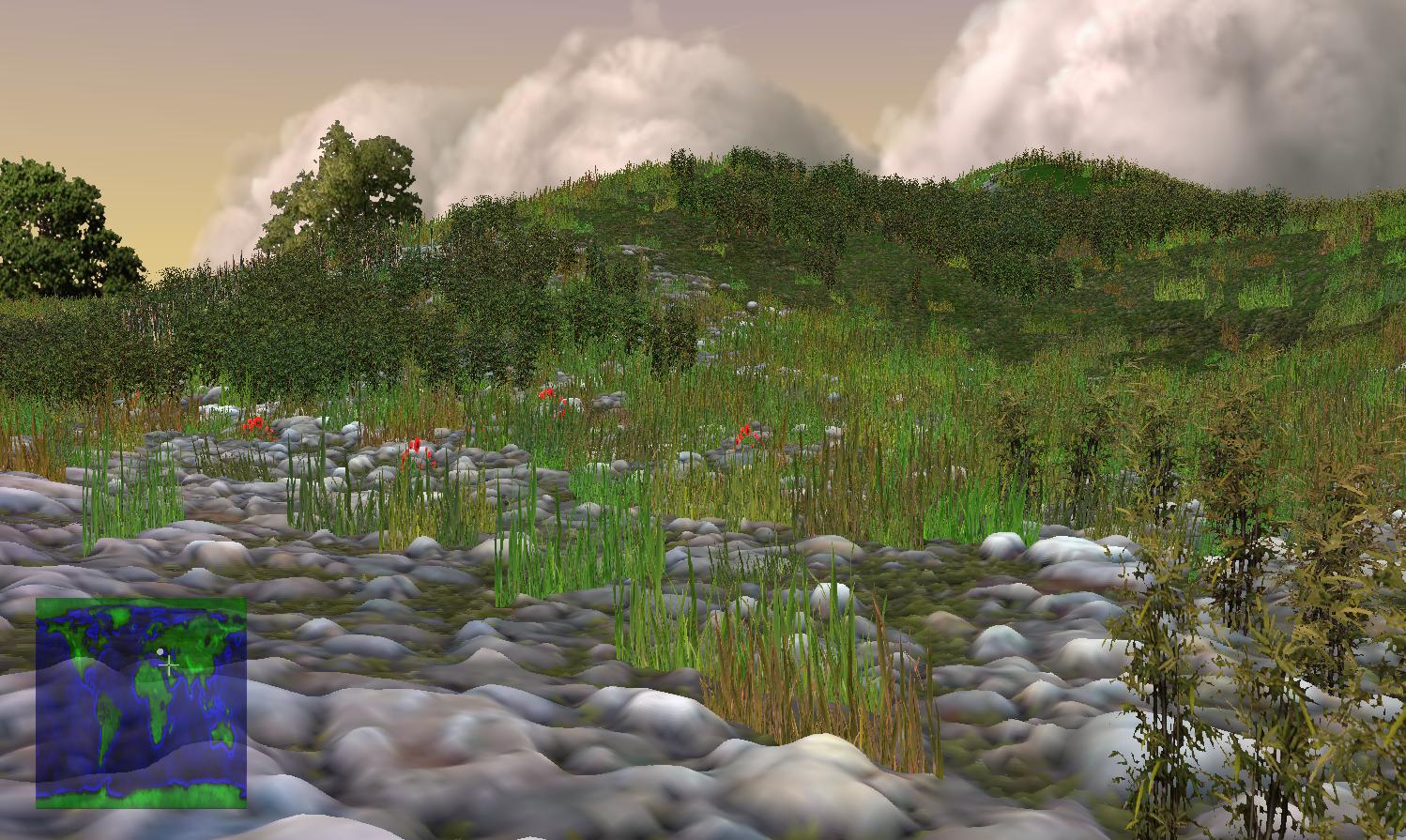
Had a great time on Monday doing craft with one of my daughters. She always wants to make something and this time had the great idea of building a model world. "Not a flat one, a round one". Excellent! That's just what I like doing. I created one a few years ago on the computer. Took me ages to write, with thousands of lines of code. It's terribly out of date now but at the time I was really pleased with it as it's not built on a 2D plane but a 3D sphere. It only has a 2km radius but has the same height data as the real world so you can walk over England or Africa etc. I never got to do shadows but I did do clouds and 3D bumpy surfaces. The animals are very poor though. Here is a video of it. I had terrible trouble exporting it so sorry if it doesn't work or is poor quality. 

Building 3D worlds has always struck me as a very godly pursuit reminding me that I am made in the image of a creative God (that was my slightly forced justification for spending ours working on it anyway!). In the first chapter of Genesis God speaks things into being. Not unlike programming :-) These days though time is too short to spend all night hunched over a keyboard coding. There are more pressing aspects of God's kingdom to give my energies too.
Luckily one of them is giving quality time to my family by building 3D spherical worlds! Right now our new one is downstairs drying. We made it by wrapping a PVA glue and tissue paper "fiberglass" shell around a football. Next we will cut it open to remove the football. Then glue it back together. It's already got a sea and continents so just needs some trees and houses. The final plan is to put a light inside it so it glows: Can't wait to say "let there be light, and there was a small PVA glue globe, and it was a good" and so on. 

Tuesday, 20 July 2010

A brilliant version of the bible for Adults and Children alike

When I first became a Christian I was so daunted by the size of the bible and particularly the Old Testament that I decided to buy a children's version to get a quick overview. While it did help me a bit with the bare bones of some of the main events, like many children's bible stories it was heavily sanitised plus I was left with the feeling that it was just a collection of unconnected faintly moralising stories without much of a plot running through them.

More recently, having actually read the OT for real, I was looking for a version for my children to read. They had three or four versions already but they all suffered from the same problems that I had encountered before. It was never obvious reading about Abraham, David, or Jonah what the point of the stories was. If someone loves Jesus and has decided to follow him why wade through the OT? Jazzing it up in colourful language and pictures may keep a child's attention but what's the point if it doesn't tell them about Jesus? Recently a friend recommended "The Jesus Storybook Bible : Every story whispers his name", and we have so far listened to/read the first third. I have to say it's absolutely brilliant. It is written soooooo well, it's exciting, funny and interesting but also very insightful and Jesus focused. Each story clearly points to Jesus in ways that even I hadn't fully appreciated before. I really cannot sing it's praises enough.   

Here's the introduction:

The heavens are singing
about how great God is;
and the skies are shouting it out, "see what God has made!"
Day after day ... night after night ...
they are speaking to us.
Psalm 19:1 -- 2 (paraphrase)

God wrote, "I love you" -- he wrote it in the sky, and on the Earth, and under the sea. He wrote his message everywhere! Because God created everything in his world to reflect him like a mirror -- to show us what he is like, to help us know him, to make our hearts sing. The way a kitten chases her tail. The way red poppies grow wild. The way a dolphin swims. And God put it into words, too, and wrote it in a book called "the Bible."

Now, some people think the Bible is a book of rules, telling you what you should and shouldn't do. The Bible certainly does have some rules in it. They show you how life works best. But the Bible isn't mainly about you and what you should be doing. It's about God and what he has done.

Other people think the Bible is a book of heroes, showing you people you should copy. The Bible does have some heroes in it, but (as you'll soon find out) most of the people in the Bible aren't heroes at all. They make some big mistakes (sometimes on purpose). They get a afraid, run away. At time are downright mean.

No, the Bible isn't a book of rules, or a book of heroes. The Bible is most of all a story. It's an adventure story about a young hero who comes from a far country to win back his lost treasure. It's a love story about a brave prince who leaves his palace, his throne -- everything -- to rescue the one he loves. It's like the most wonderful of fairytales that has come true in real life!

You see, the best thing about this story is -- it's true. There are lots of stories in the Bible, but all the stories are telling one big story. The story of how God loves his children and comes to rescue them.

It takes the whole Bible to tell this story. And at the centre of this story there is a baby. Every story in the Bible whispers his name. He is like a missing piece of the puzzle -- the piece that makes all the other pieces fit together, and suddenly you can see a beautiful picture.

And this is no ordinary baby. This is the child upon whom everything would depend. This is the child who would one day -- but wait. Our story starts were all good stories start right at the beginning ...

It really is the best Children's' bible I have ever come across. The author is Sally Lloyd-Jones. Is she related to "the Lloyd Jones?" I'll let her answer that from her blog:

When you're such a fan, of such a great man, of course you'd love to be able to say you're related or connected somehow. You wish you had met him. And been able to hear him preach. Or had him as your great Uncle. You sometimes even wish (inappropriately) you could tell all manner of lies to make it a better story--you remember him singing welsh hymns to you, he took you riding on his horse--in short, you wish you could say anything other than, "no". Which for some reason I can't help but follow with "sorry". (I feel it is such a let down and I'm rather let down by the whole thing myself.)

I don't think she needs to feel sorry at all. The truth is, asking the question is a massive compliment because given her amazing gift of writing and insight into truth being related to the late great Lloyd-Jones is a very plausible possibility. Another recognisable name that cropped up was Tim Keller. Sally says he had some input into the book and a little research confirms it is indeed "the Tim Keller".

If you have young children and you're looking for a great bible story book then this is the one to get. It's also a good one to listen too (the Deluxe version has a great set of CD's with it) if you have just become a Christian and want to get a quick feel for the whole bible story. Not only will it inspire you to read the "real thing" it will help you listen for the whispers of Jesus in every story.


Monday, 19 July 2010

Who created God?

Richard Dawkins
At the centre of Richard Dawkin's "God Delusion" book is the question "Who created God?" It's supposed to be a devastating blow to the credibility of Christianity rendering speechless those who believe in a creator God. It has always baffled me as to why that is such a problematic question. The answer is "no one created God. He is uncreated. Why is that a problem?"

John Lennox
John Lennox points out that the question can just as well be asked of naturalists : "Who or what created matter and energy?" If the answer is that they have always existed then they obviously have no problem with something being uncreated. If the answer is that matter and energy came into being at some stage then something must have caused their appearance and we either have to take that as eternally existent or the thing before that or before that and so on but the buck has to stop somewhere. Something somewhere must have been eternally existent and the first cause of everything. You can't have an infinite sequence of past causes or we would never arrive at the present.http://johnlennox.org/index.php/en/resource/who_created_the_creator/

I think the real sticking point though is Dawkins' view that something cannot be a valid explanation or cause if it is in fact more complex. That seems to be a firmly held presupposition, and is in fact at the heart of a reductionist worldview. While it has proved a very fruitful expectation in understanding many things, there is no reason to think it is true of everything. Can you reduce personhood, consciousness, love, information or  morality? There is nothing wrong in trying but do we want to rule out the possibility that a person is the source of person hood ahead of time? Could there not be some highly complex, beautiful, loving and morally perfect being behind everything? Looking for simpler explanations of more complex phenomena is a very valid pursuit and one that works because the universe does seem, in many ways, remarkably ordered but it is a step of faith, or at least a big inductive jump, to say that all valid explanations are in terms of simpler phenomena.

One final point: I have heard people argue that when we find ancient ruins we ascribe intelligent design to them, i.e people made them. This is helpful in that it gives an example of a more complex cause (a person) for a simple phenomena (some scratches in a stone) but it fails to be relevant here because it is not a closed system.  Dawkins and others would simply say that there is a series of increasingly simple explanations for the person, in terms of evolution, and therefore there is ultimately a simpler explanation for the scratches. When we are talking about an uncreated creator there is no possibility of a simpler sequence of causes behind his apparent complexity because there is, by definition, nothing before him. That is why the assumption that "a valid explanation must ultimately be in terms of a less complex cause" needs to be challenged.


I might be missing something but it seems to me that the "who created God question" is not the deal breaker that people think it is.